How to Sell a Property with Damp (Without Fixing)
Got damp issues in your property and worried you can’t sell?
Here’s what most estate agents won’t tell you upfront.
You can absolutely sell a house with damp – and you don’t necessarily need to fix it first. In fact, over the past three years at Property Rescue, we’ve purchased more than 500 properties, many with significant damp problems.
I’m Danny, and I’ve been buying properties in England and Wales for over 20 years.
In this guide, I’ll walk you through exactly how to sell a property with damp: your legal obligations, what buyers actually care about, and the three routes you can take (traditional sale, cash buyer, or auction). Everything here comes from real transactions – not theory.
Let’s start with the basics.
What is Damp?
First things first: not all damp is created equal.
Damp is excess moisture present in buildings that can lead to major issues if left untreated. But before you panic, understand that there are four distinct types – and some are far easier (and cheaper) to deal with than others.
Here’s what you need to know:
1. Rising Damp
Ground moisture seeping up through walls, typically because the damp proof course (DPC) has failed or is absent. You’ll usually see a “tide mark” about 1 metre up from floor level.
2. Penetrating Damp
Water coming in from outside through the roof, walls, windows, or door frames. Often caused by damaged rendering, missing roof tiles, or faulty guttering.
3. Condensation Damp
Moisture in the air condensing on cold surfaces – most common in bathrooms, kitchens, and poorly ventilated properties. This is the most common type and usually the easiest to fix.
4. Water Leaks
Active leaks from damaged or burst pipes, often hidden behind walls or under floors.
In my experience, rising damp and penetrating damp are what worry buyers most, because they typically need professional treatment and can be expensive to fix properly.
Now you know what damp is, let’s look at what actually causes it.
Causes of Major Damp Problems
Why does damp happen in the first place?
Understanding what causes damp helps you (and potential buyers) grasp the full picture.
The most common causes we see are:
- Structural defects: Cracked walls, damaged roofs, deteriorating pointing
- Plumbing failures: Burst or leaking pipes, faulty seals around baths and showers
- Failed damp proof courses: Original DPC has deteriorated or been bridged by external ground levels
- Poor ventilation: Inadequate airflow causing condensation buildup
- Blocked gutters or downpipes: Water overflowing and penetrating walls
- Render or external wall problems: Cracks allowing water ingress
Here’s what’s important: A professional damp survey is the only way to correctly diagnose the root cause.
Guessing or assuming what type of damp you have can lead to expensive mistakes.
Did You Know?
Industry estimates suggest around 5% of UK properties have genuine rising damp, but many more are diagnosed with it incorrectly. Poor ventilation (condensation) is actually the most common moisture problem in UK homes.
Before you think about selling, you need to know exactly what you’re dealing with. Here’s how to spot the warning signs.
How to Identify Damp Signs
Before you sell, you need to know what you’re dealing with.
Look for these telltale indicators:
- Peeling paint or wallpaper – especially near skirting boards or external walls
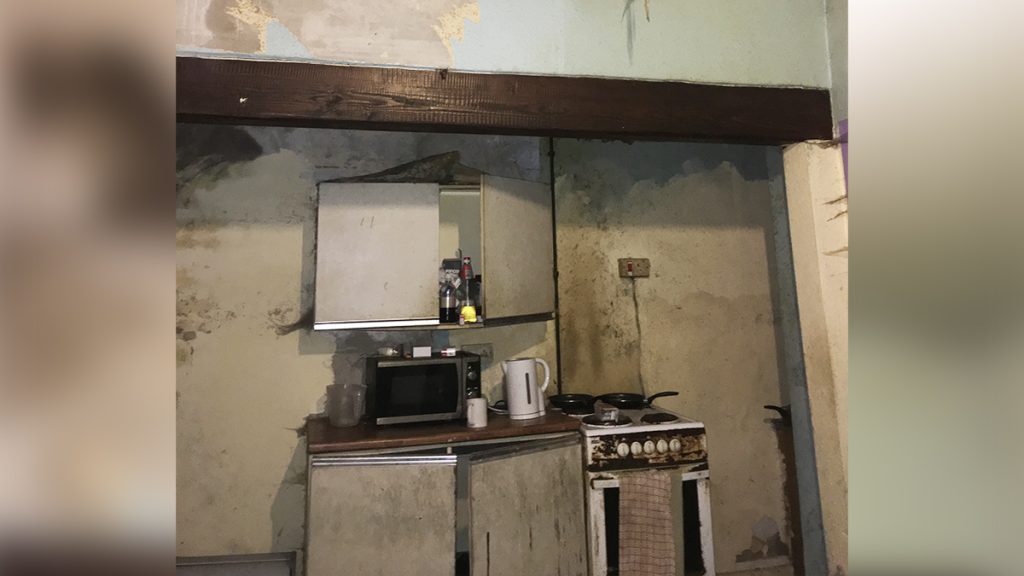
- Dark patches or staining on walls and ceilings
- Musty, earthy odour – that distinctive damp smell
- Crumbling plaster that’s soft to the touch
- Visible mould growth – black spots, especially in corners
- Condensation buildup on windows and cold surfaces
- Water stains near plumbing fixtures
- Rust stains on metal radiators or fixtures
- Decaying timber in window frames or skirting boards
- Salt deposits (efflorescence) on walls – a white, powdery residue
If you’re seeing multiple signs, it’s time to get professional advice before you list the property.
But here’s the crucial bit: before you even think about marketing your property, you need to understand your legal position. And this is where many sellers get it wrong.
Your Legal Obligations When Selling With Damp
Here’s where things get serious.
Let’s talk about something crucial that many sellers don’t fully understand: your legal duty to disclose damp issues.
Can you just hide the damp and hope the buyer doesn’t notice? Absolutely not. And here’s why.
The Law on Disclosure
As a private seller, you have a legal duty to answer pre-contract enquiries (such as the TA6 Property Information Form) honestly and to the best of your knowledge under the Misrepresentation Act 1967. While the principle of caveat emptor (buyer beware) applies to physical defects, you must not actively lie or mislead buyers when asked direct questions.
Estate agents acting on your behalf must comply with the Digital Markets, Competition and Consumers Act 2024, which requires them to proactively disclose material information that affects a buyer’s decision.
In plain English: you cannot hide damp problems from potential buyers when asked, and your estate agent has a legal duty to disclose material defects.
Full stop.
If the property is currently let to tenants, separate fitness-for-habitation duties apply. In England, the Homes (Fitness for Human Habitation) Act 2018 requires landlords to ensure rented properties meet minimum habitability standards. Serious damp issues could breach this obligation. In Wales, equivalent duties arise under the Renting Homes (Wales) Act 2016. These are tenancy obligations rather than sale-disclosure rules, but they matter if you’re selling a tenanted property.
What Happens If You Don’t Disclose?
Concealing damp is risky for several reasons:
- Surveys will find it: Most buyers commission a homebuyer’s report or full building survey. Damp will be flagged, and the buyer will feel deceived.
- Sales fall through: When buyers discover undisclosed problems, they often pull out entirely rather than renegotiate.
- Legal action: Buyers can pursue you after completion for misrepresentation or concealment, potentially costing you far more than being upfront.
- Legal consequences: If you or your solicitor provide false information, a buyer may bring a civil misrepresentation claim after completion. In extreme cases, deliberately fraudulent conduct could amount to a criminal offence. Criminal consumer-protection rules (under the Digital Markets, Competition and Consumers Act 2024) are mainly relevant to estate agents and other traders, not ordinary private sellers.
My advice after 20+ years in this business: Honesty upfront saves time, money, and stress. Every time.
Legal Disclaimer: This guidance is general information only and should not be relied upon as legal advice. For your specific situation, consult a qualified solicitor and obtain professional surveys from RICS-qualified surveyors or PCA-registered specialists.
So we’ve covered the legal side. Now the question you’re really asking: can you actually sell a property with damp in today’s market?
The short answer: yes. The longer answer: it depends.
Can You Really Sell a Property With Damp?
Got time on your side? Read the traditional market route section below.
Need to sell fast? Skip ahead to the cash buyer section.
Want to see all your options? Read everything – it’ll take 10 minutes and could save you thousands.
The Traditional Market Route
Selling through an estate agent with damp present is possible, but you need to understand the challenges.
And the challenges are real.
Mortgage implications: This is the biggest hurdle. Many mortgage lenders are reluctant to lend on properties with significant damp issues – particularly rising damp or penetrating damp that requires remedial work. This immediately reduces your buyer pool to:
- Cash buyers only, or
- Buyers whose lenders will accept the property subject to retention (money held back for repairs)
Buyer concerns: Damp triggers anxiety in buyers. They worry about:
- Hidden structural damage
- Ongoing costs after purchase
- Future resale difficulties
- Health implications (mould, respiratory issues)
Survey downgrades: A homebuyer’s report will flag damp issues. A full structural survey will detail them extensively. Either way, buyers will demand price reductions or repairs before exchange.
Longer timescales: Properties with damp typically take longer to sell. Many end up on the market for 6+ months or longer because the property’s condition puts buyers off.
Many sellers find themselves on the market for 6+ months due to poor valuation, a mismatched agent, or slow solicitors. When property condition is the issue, traditional sales become even more challenging.
The Reality Check
Let me be blunt.
From working with hundreds of sellers, here’s what typically happens with a damp property on the traditional market:
- Initial interest is lower (fewer viewings)
- Serious buyers commission surveys
- Surveys reveal the damp and estimate repair costs
- Buyers either pull out or renegotiate heavily
- If the damp affects mortgageability, only cash buyers remain
- Price reductions are substantial (often 20-30% depending on severity)
- The process takes months longer than normal sales
That said, if you have time and your property has other strong selling points, the traditional route can work – especially if the damp is minor (condensation-related) or easily fixed.
So if you’re determined to go the traditional route, here’s your step-by-step game plan.
Steps to Sell a Property With Damp (Traditional Route)
Here’s your game plan:
1. Get a Professional Damp Survey First
This is non-negotiable.
Before you list, commission your own damp survey from a RICS-qualified surveyor or PCA-registered specialist.
This typically costs £200-500 but gives you:
- Accurate diagnosis of damp type and cause
- Detailed treatment recommendations
- Cost estimates for remedial work
- A report you can share with potential buyers
Why do this upfront?
Because it shows buyers you’re being transparent, and you can price the property appropriately from the start rather than facing multiple renegotiations.
2. Get Repair Cost Estimates
Armed with the damp survey, get written quotes from at least two specialist damp treatment companies.
Here’s what you’re likely looking at (these are ballpark figures – actual costs vary significantly by property):
- Condensation treatment (improved ventilation, dehumidifiers): £500-2,000
- Rising damp treatment (new DPC injection, replastering): £2,000-5,000 for a typical room
- Penetrating damp repairs (roof work, repointing, render): £1,500-8,000+ depending on extent
- Extensive structural work (multiple rooms, serious issues): £10,000-30,000+
These figures give you a realistic basis for pricing your property.
3. Inform Your Estate Agent Upfront
Don’t hide the damp from your agent.
Seriously – don’t.
A good agent will:
- Adjust the asking price to reflect the condition
- Market the property honestly to avoid wasted viewings
- Target cash buyers and investors
- Manage buyer expectations from day one
In my experience, agents who don’t know about problems waste everyone’s time with buyers who’ll never complete once the survey comes back.
4. Be Transparent in All Marketing
Make sure the property listing mentions:
- “Requires some cosmetic updates” (for minor issues)
- “Sold with the benefit of a recent damp survey” (if you commissioned one)
- “Priced to reflect condition” (signals you’ve adjusted for issues)
- “Ideal for cash buyers or investors” (if mortgageability is affected)
You don’t need to say “THIS HOUSE HAS TERRIBLE DAMP” in the headline. But honesty in viewings and written materials is essential.
5. Make Cosmetic Improvements Where Possible
While you’re not fixing the damp itself, you can improve presentation.
Think of it as damage limitation:
- Treat visible mould with anti-mould wash
- Touch up flaking paint (after treating mould)
- Improve ventilation (open windows, add trickle vents)
- Run a dehumidifier to reduce moisture levels
- Ensure the property is warm and dry during viewings
These small steps won’t fix underlying problems, but they reduce the visual impact and make the property more appealing.
6. Highlight Positive Features
Properties with damp still have value.
Make sure your marketing emphasizes:
- Location and local amenities
- Garden or outdoor space
- Period features or architectural interest
- Potential (for renovation/development)
- Recent updates to other areas (new kitchen, etc.)
Buyers need to see the opportunity, not just the problem.
7. Be Flexible on Pricing and Terms
Here’s the reality: buyers will negotiate hard.
Expect them to want:
- Price reductions to cover repair costs (plus a margin)
- Fast completion if they’re cash buyers
- Retention clauses if they’re using a mortgage
When you factor in estate agent fees (typically around 1.2-1.5% plus VAT), legal costs, the time value of money, and repair costs or price reductions, sellers often net around 90-95% of the property’s perfect-condition market value anyway.
That brings us to the alternative approach: selling directly to a cash buyer. This isn’t for everyone, but for many sellers with damp properties, it’s the fastest and least stressful option.
The Alternative: Selling to a Cash Buyer
Here’s where companies like Property Rescue come in.
How Cash Buying Works for Damp Properties
We buy properties in any condition, including those with significant damp issues. Here’s the process:
1. Initial Enquiry – You contact us with basic details about your property and situation.
2. Preliminary Offer – We typically provide a cash offer of your enquiry, based on the information you’ve shared.
3. Valuation – We conduct our own fact-finding and underwriting valuation. Our asset management team gathers videos and photos, and we consult with two local agents to ensure our offer is fair.
4. Final Offer – After our valuation, in 90% of cases, our final offer is within 95% of the initial one. We adjust for the damp and any other issues, but we’re not going to dramatically drop the price once we’ve seen it.
5. Legal Work – Once you accept, we handle the legal process. Our average exchange time from initial enquiry is 7 days, with an average completion time of 28 days from offer acceptance.
6. Completion – You receive your money, and we take on the property with all its issues – no repairs needed from you.
When Cash Buying Makes Sense
Is a cash buyer right for you?
A cash sale is most appropriate if:
- You’re facing repossession risk and need to act quickly
- The property is in poor condition with multiple issues
- You’ve tried the open market for 6+ months without success
- You need a certain completion date
- You want to avoid the stress and uncertainty of traditional sales
- The property is unmortgageable in its current state
About 95% of our sales complete within four weeks after offer acceptance. In fact, our fastest exchange was just 7 days from enquiry to exchange of contracts for a seller facing repossession.
When Cash Buying Doesn’t Make Sense
Let me be honest: a cash sale isn’t ideal for every seller.
If your property is in good condition (apart from minor damp), you’re in a strong market area, and you have 6-12 months to sell traditionally, you’ll likely get more money on the open market.
Cash buyers like us offer speed, certainty, and convenience – not maximum price. It’s a trade-off, and you need to decide what matters most in your situation.
Before you make a decision, there’s one more selling route worth considering.
What About Auction?
Forget traditional sales and cash buyers for a moment.
Property auction is another option for damp properties.
Pros:
- Fast sale (usually 28 days from hammer to completion)
- Attracts investors and cash buyers
- Properties sell “as seen” without guarantees
- No renegotiation after the hammer falls
Cons:
- Upfront costs (entry fees, legal packs, marketing)
- No guarantee your property will sell (reserve prices can be tricky)
- Final price can be unpredictable
- Still requires legal work and preparation
Auction works well for properties with clear development potential, unusual characteristics, or significant issues. It’s worth considering alongside other options.
Right, we’ve covered a lot of ground. Let’s bring it all together.
Key Takeaways
We’ve covered a lot. Here’s what you need to remember:
- You can sell with damp – it’s legal and happens every day
- Disclosure is essential: answer all buyer enquiries (including the TA6 form) honestly under the Misrepresentation Act 1967
- Get a survey first – Know what you’re dealing with before you price or market
- Traditional sales are possible – but expect longer timescales and reduced buyer pool
- Mortgage implications are significant – many lenders won’t lend on damp properties
- Cash buyers are your main market – whether private or companies like us
- Price adjustments are inevitable – factor in repair costs plus buyer margin
- Honesty saves time – concealment leads to collapsed sales and potential legal issues
- Consider all options – traditional sale, cash buyer, auction, or partial repairs
- Professional advice is essential – use RICS surveyors and qualified solicitors
Your next step? Get a professional damp survey if you haven’t already. That single report will tell you exactly what you’re dealing with, what it’ll cost to fix, and how to price your property realistically. From there, you can decide whether to go traditional, cash buyer, or auction.
Don’t guess. Get the facts first.
Frequently Asked Questions
Do I legally have to tell buyers about damp?
A private seller is not under a blanket duty to volunteer every physical defect, the principle of caveat emptor (buyer beware) still applies. However, when asked direct questions on forms like the TA6, you must answer honestly and accurately under the Misrepresentation Act 1967. Lying or deliberately concealing known damp issues can result in legal action against you after the sale completes.
Your estate agent has separate, broader legal duties under the Digital Markets, Competition and Consumers Act 2024 to proactively disclose material information to buyers.
How much does damp reduce property value?
It varies significantly based on severity. Minor condensation issues might reduce value by 5-10%. Serious rising or penetrating damp requiring extensive treatment can reduce value by 20-30% or more. The key factor is mortgageability – if lenders won’t lend, you’re limited to cash buyers.
Can buyers get a mortgage on a property with damp?
It depends on the type and severity. Minor condensation issues rarely affect mortgages. Significant rising or penetrating damp will often result in lenders refusing to lend or offering a retention mortgage (holding back funds until repairs are completed). Many sellers find that damp effectively makes their property “cash buyers only.”
Should I fix the damp before selling?
Not necessarily. If repairs are minor (under £2,000) and will significantly improve mortgageability, it might be worth it. But for major work costing £5,000+, you may not recoup the investment. Often, selling “as is” with an honest price reduction is more practical. Get quotes and do the maths before deciding.
How long does it take to sell a property with damp?
Through traditional estate agents: typically 3-9 months, sometimes longer if the damp is severe. Through a cash buyer like Property Rescue: we average 28 days from offer acceptance to completion, with our fastest case completing in just 7 days from initial enquiry to exchange.
What’s the difference between a homebuyer’s report and a damp survey?
A homebuyer’s report is a general survey that identifies potential issues, including damp. A specialist damp survey is more detailed, specifically diagnoses damp type and cause, and provides treatment recommendations and costs. For a property you know has damp, commission both – your surveyor can recommend specialists.
Will estate agents take on a property with damp?
Most will, but expect them to adjust your asking price significantly and be honest in marketing. Some agents may decline properties with severe issues. Be upfront in your initial conversations – good agents appreciate honesty and can target the right buyers.
Can I sell a property that has damp to my family?
Yes, but you still have legal disclosure obligations under the Misrepresentation Act 1967. Failing to disclose known damp issues could damage relationships as well as result in legal claims. Be especially careful with family transactions – document everything.
Need to Sell Your Property With Damp?
If you’re facing damp issues and need to sell quickly without the stress of repairs, surveys, and lengthy traditional sales, we can help.
At Property Rescue, we’ve been buying properties across England and Wales for over 20 years. Because of our Sale and Rent Back service, we’re one of the only house buying companies in the UK that’s regulated by the FCA, and we’ve completed over 500 purchases in the last three years alone – many with damp and other condition issues.
Here’s what you can expect:
- Free, no-obligation cash offer
- No need for expensive surveys or repairs at your cost
- Average completion in 28 days from offer acceptance
- 95% of our sales complete within four weeks
- Transparent, professional service throughout
We’re not right for everyone – but if speed, certainty, and convenience matter more than squeezing every last pound from a traditional sale, we’d love to talk.
Get your free, no-obligation offer
Or call our friendly team on 020 8634 0224
Many of our clients tell us that our compassionate and professional service makes stressful situations easier. We’re here to help, not to pressure you.
Disclaimer: This article provides general guidance only and should not be relied upon as professional advice. Property law, consumer protection regulations, and building standards are complex and situation-specific. Always consult qualified professionals including RICS-qualified surveyors, PCA-registered specialists, and solicitors for advice tailored to your specific circumstances. Property Rescue is a trading name of Property Rescue Limited (Reg No. 05636616), FCA-regulated for our Sale and Rent Back service. Information accurate as of March 2026.